
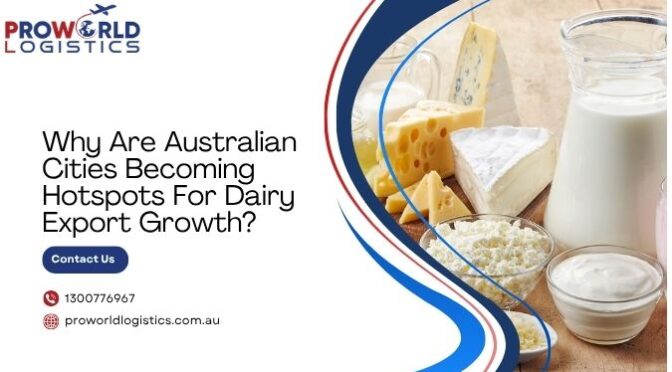
Long before a carton of milk or a block of cheddar reaches a supermarket shelf overseas, it begins as a quiet story of paddocks, cool mornings, and tankers rolling toward processing plants. Australia’s dairy belt has always carried this rhythm, but in recent years the story has grown bigger than the farm gate. Dairy export in Melbourne has become a defining chapter in this journey, with the city’s port infrastructure and cold storage networks turning fresh milk into a global commodity within days.
Ready to move your dairy shipment with confidence? Reach out to Proworld Logistics, the best logistics company today and discover freight solutions built around reliability, not shortcuts.
The Journey From Paddock To Port
Every export shipment carries a backstory that rarely makes headlines. Refrigerated trucks leave processing plants before sunrise, carrying pallets of cheese, butter, and milk powder toward container terminals. This is where cold chain logistics for dairy becomes the invisible backbone of the industry, ensuring that temperature never drifts, even as cargo crosses oceans. Without this precision, the entire promise of freshness collapses somewhere between the warehouse and the wharf.
Dairy export in Perth and Adelaide has quietly built their own reputations, each contributing a distinct rhythm to the national supply chain that keeps dairy moving from paddock to port without losing freshness or quality.
Melbourne’s Role In The National Dairy Story
Victoria has long been considered the heartland of Australian dairy farming, and its port city reflects that legacy. Dairy export in Melbourne benefits from proximity to some of the country’s largest processing facilities, allowing shorter transit times between farm and freight.
The dairy supply chain in Melbourne thrives on this closeness, reducing the risk of spoilage while keeping export costs competitive against other global suppliers.
Perth’s Growing Influence On Western Trade Routes
On the western coast, a different kind of momentum has been building. Dairy export in Perth connects Australian producers to markets across Southeast Asia and the Middle East through comparatively shorter shipping distances.
This geographic advantage has turned dairy freight forwarding in Perth into a strategic asset, particularly for exporters chasing faster delivery windows without compromising on quality control.
Looking for a logistics partner who understands cold chain precision? Talk to Proworld Logistics, a reputed logistics company and let experienced hands manage your next export cycle.
Adelaide’s Quiet But Steady Contribution
South Australia rarely dominates the conversation the way its larger neighbours do, yet its dairy sector tells a story of consistency. Dairy export in Adelaide has grown through steady investment in packaging and processing technology, allowing smaller producers to compete on the international stage.
The milk powder export industry in Adelaide has particularly benefited from this shift, as bulk shipments require precise handling that only well-coordinated logistics networks can guarantee.
Why Consistency Matters More Than Speed
In dairy trade, speed alone rarely wins contracts. Buyers overseas care more about reliability, whether a shipment arrives exactly as promised, batch after batch. This is why dairy export in Melbourne has repeated success, not because it is the fastest route, but because it has built systems that rarely fail.
Similarly, dairy export in Adelaide continues gaining ground by proving that smaller volumes, handled with precision, can still meet the exacting standards of international buyers.
The Role Of Technology In Modern Dairy Logistics
Sensors, real-time tracking, and predictive temperature monitoring have quietly transformed how dairy moves across borders. Dairy export in Perth has embraced these tools to shorten the gap between uncertainty and confidence, giving buyers visibility into their cargo long before it docks.
This shift toward smart dairy freight tracking reflects a broader industry trend where data now travels alongside the product itself.
Meeting Global Standards Without Losing Local Character
Every exporting region carries its own identity, shaped by soil, climate, and farming tradition. Yet global markets demand uniform compliance, food safety certifications, packaging standards, and documentation accuracy. Balancing this tension is where Australian dairy export compliance becomes critical, ensuring that regional character survives the standardisation process required for international trade.
Want your dairy products to reach global markets without compromise? Partner with Proworld Logistics and turn every shipment into a story of consistency and trust.
Where Proworld Logistics Fits Into This Story
Behind every successful shipment lies a logistics partner capable of managing complexity without losing sight of the details that matter. Proworld Logistics a renowned logistics company, has built its reputation around exactly this kind of dependable coordination, connecting dairy producers across Melbourne, Perth, and Adelaide with international markets through carefully managed freight solutions.
Frequently Asked Questions about dairy export
- What makes Australian dairy attractive to international buyers?
Consistent quality, strict food safety standards, and reliable cold chain handling make Australian dairy a trusted choice across global markets.
- Why is Melbourne considered a major hub for dairy export?
Its proximity to processing plants and established port infrastructure allows faster, more efficient shipping cycles.
- How does Perth benefit dairy exporters targeting Asian markets?
Its western coastal location shortens shipping distances to Southeast Asia and the Middle East, reducing transit time.
- What role does Adelaide play in Australia’s dairy trade?
Adelaide supports smaller and mid-sized exporters through precise processing and packaging technology suited for bulk shipments.
- What is cold chain logistics, and why does it matter for dairy?
It refers to temperature-controlled transport systems that prevent spoilage and maintain product integrity throughout the journey.
- How is technology changing dairy export logistics?
Real-time tracking and predictive monitoring now allow buyers to follow cargo conditions before it even arrives.
- What compliance standards apply to dairy exports from Australia?
Exporters must meet food safety certifications, labelling accuracy, and destination country import regulations.
- Which dairy products are most commonly exported from Australia?
Milk powder, cheese, butter, and UHT milk remain among the most frequently shipped dairy products.
- How does packaging affect the success of a dairy export shipment?
Proper packaging prevents contamination, maintains freshness, and ensures compliance with international handling standards.
- Why do reliability and consistency matter more than shipping speed?
Buyers prioritise dependable delivery over speed, since inconsistent shipments risk long-term trade relationships.

